Refinancing a mortgage is the process of replacing your existing home loan with a new one, typically to secure a lower interest rate, change the loan term, or access home equity. While refinancing can be a powerful financial move that saves you tens of thousands of dollars, it is not the right choice for everyone. Understanding when to refinance—and when to hold off—is critical.

When you refinance, a new lender pays off your old mortgage, and you begin making payments on the new loan. The new loan has its own terms, interest rate, and closing costs. There are two primary types of refinancing:
This is the most common type. The goal is to obtain a better interest rate, a different loan term (like switching from a 30-year to a 15-year mortgage), or both. If interest rates have dropped significantly since you bought your home, a rate-and-term refinance can lower your monthly payment and reduce the total interest you pay over the life of the loan. Use our mortgage calculator to see your potential new payment.
A cash-out refinance allows you to borrow more than you owe on the home and receive the difference in cash. For example, if your home is worth $400,000 and you owe $250,000, you could refinance for $300,000 and pocket $50,000. This is often used to pay off high-interest debts, fund home renovations, or cover major expenses. However, it increases your loan balance and turns unsecured debt into debt secured by your home, which carries risk.
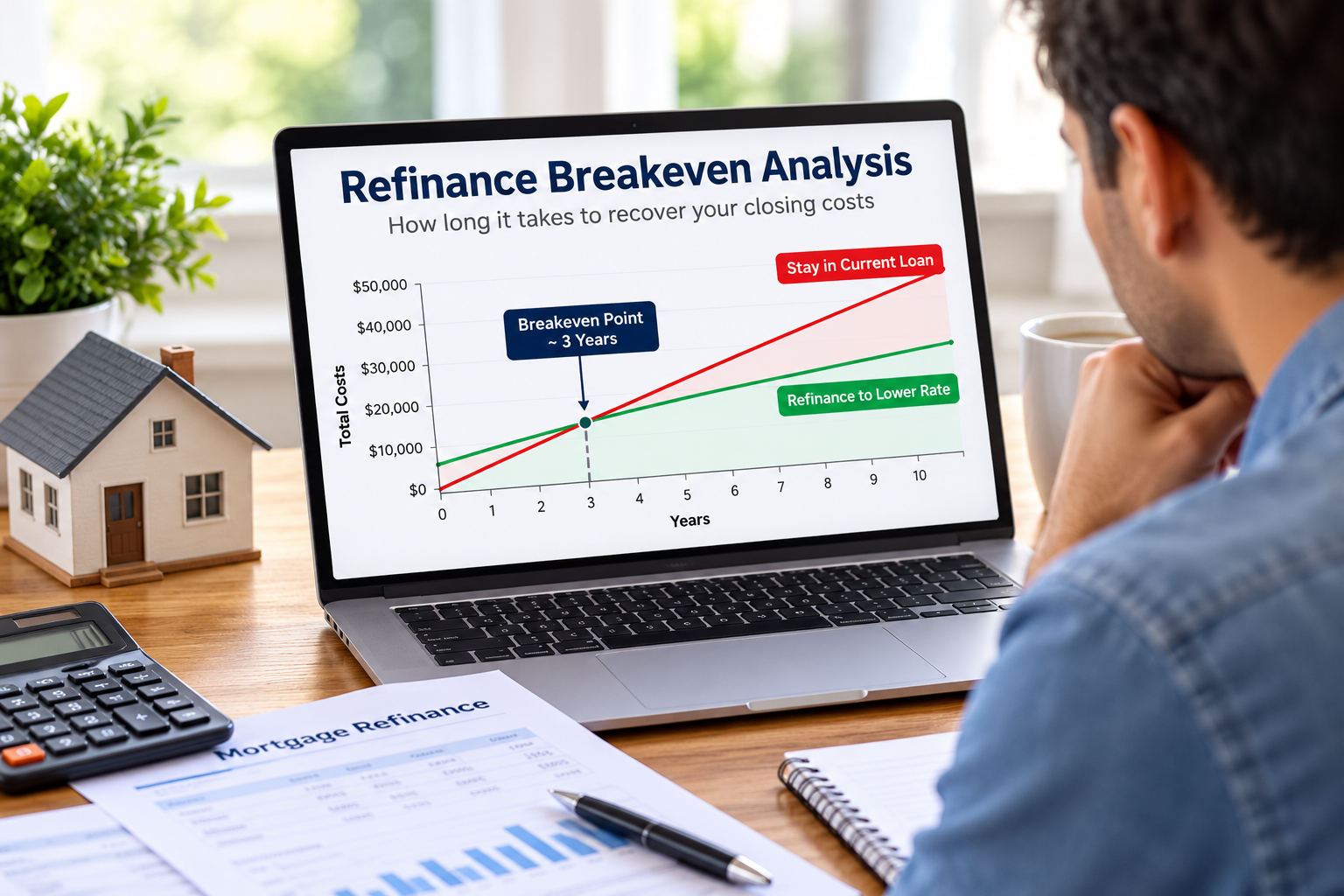
Refinancing is not free. You will pay closing costs, which typically range from 2% to 5% of the loan amount. On a $300,000 loan, that is $6,000 to $15,000. Because of these costs, you must calculate your "break-even point"—the time it takes for your monthly savings to exceed the cost of the refinance.
For example: If refinancing costs $6,000 and lowers your monthly payment by $200, your break-even point is 30 months ($6,000 ÷ $200 = 30). If you plan to sell the home or move within two years, refinancing would actually cost you money.
Financial experts generally recommend refinancing if you can lower your interest rate by at least 1% (or 0.75% for larger loans). However, the current rate environment matters. If rates have risen significantly since you bought your home, refinancing to a lower rate may not be possible. In that case, you might explore other options like a loan modification or recasting.
You also need to consider how long you plan to stay in the home. If you plan to move in the next 2-3 years, the closing costs will likely outweigh the monthly savings. Always calculate your break-even point before committing to a refinance.
Refinancing is a bad idea in several scenarios:
The refinance process is similar to getting a mortgage when you first bought the home. You will need to provide income verification, tax returns, and bank statements. The lender will order an appraisal (though some programs offer appraisal waivers). You will also pay closing costs, which can sometimes be rolled into the new loan balance (though this increases your principal).
Before you start the process, check your credit score to ensure you qualify for the best rates. A higher score will save you more money over the life of the new loan.
Use our mortgage calculator to compare your current payment with a potential new payment. Factor in the closing costs and determine how long it will take to break even. If you plan to stay in the home long-term and the numbers make sense, refinancing can be a smart financial strategy. If the math is close or you plan to move soon, it is usually best to wait.