If you bought a home in the US with less than a 20% down payment, you are likely paying Private Mortgage Insurance (PMI). It is an extra fee added to your monthly payment that protects the lender, not you. In this guide, we explain what PMI is, how much it really costs you, and the exact steps to get rid of it.
When you put down less than 20%, the lender considers you a higher risk. If you stop paying your mortgage, the lender loses money. PMI protects them by covering a portion of their loss if you default. Generally, PMI costs between 0.5% and 1.5% of your total loan amount per year. For a $350,000 loan, that could mean an extra $150 to $400 added to your monthly payment.
Even if you have excellent credit and a stable income, the lender requires this insurance because the loan-to-value (LTV) ratio is high. They want to ensure they can recoup their money if the housing market drops and you are forced into foreclosure.
Let's look at an example. Imagine you buy a $400,000 home with 10% down ($40,000). Your loan amount is $360,000. If your PMI rate is 0.8%, you are paying $2,880 per year, or $240 per month.
If you keep that loan for 5 years before removing PMI, you will have paid $14,400 purely for insurance you didn't need. That money could have gone into your savings, paid down the principal, or been invested. This is why removing PMI as fast as legally possible is one of the smartest financial moves a new homeowner can make.
There are two main ways to remove PMI from your monthly payment:
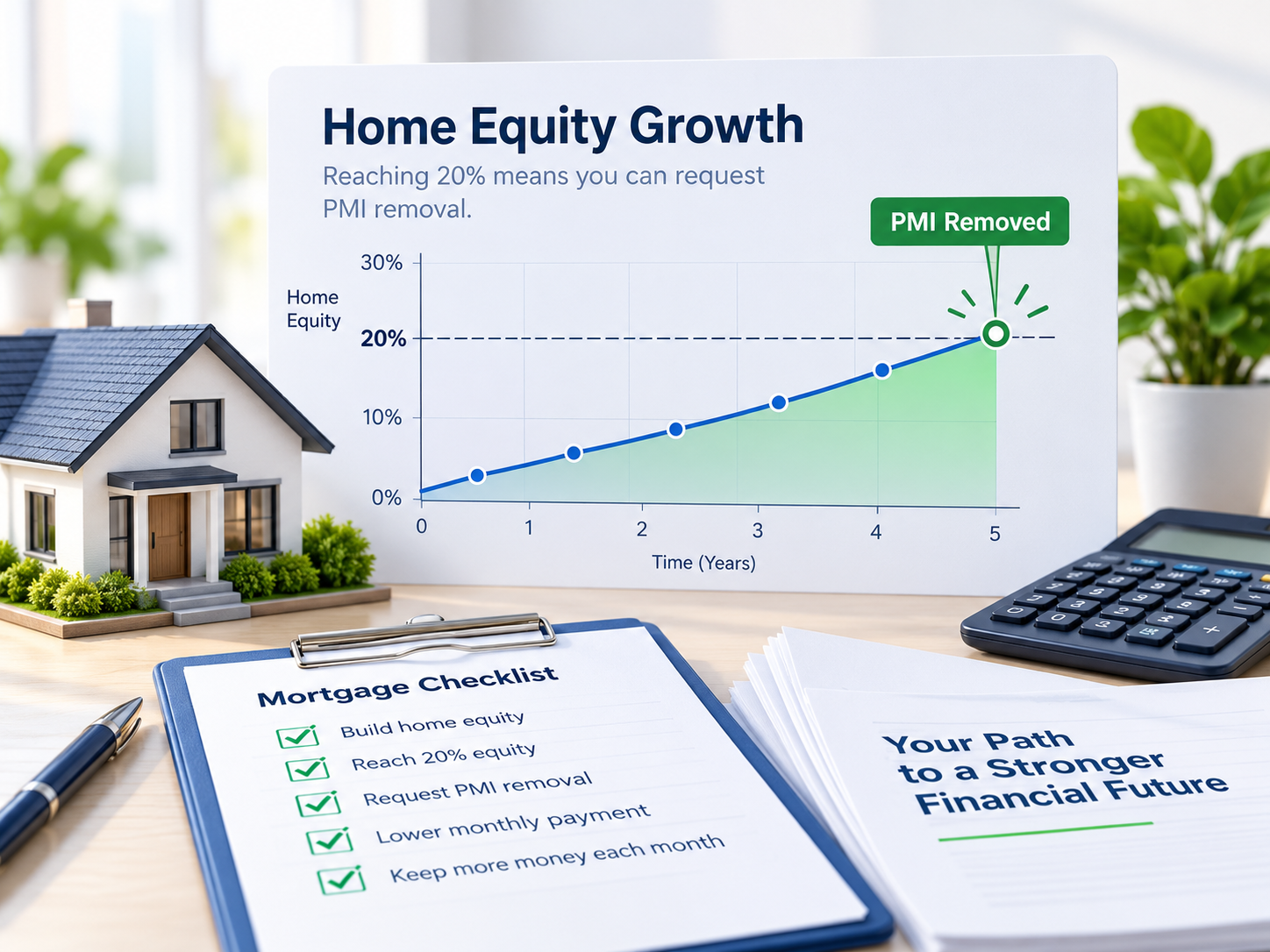
If home values in your area have skyrocketed, you might have 20% equity even if you haven't paid down 20% of the loan. For example, if you bought a home for $300,000, and local values rise so that your home is now worth $380,000, your equity has increased dramatically.
You can request an appraisal; if the new value proves you have 20% equity, you can often remove PMI much earlier! You will have to pay for the appraisal out of pocket (usually around $500), but the long-term savings on your monthly payment will usually cover that cost within a few months.
If your lender won't drop PMI based on market appreciation, you have another option: make extra principal payments. Even an extra $100 a month can significantly reduce the time it takes to reach 20% equity. Always check with your lender to ensure extra payments are applied directly to the principal balance, not to future interest payments.
You can also consider a mortgage refinance if interest rates have dropped. A new lender might offer a loan without PMI if the new appraisal shows you have 20% equity, allowing you to kill two birds with one stone: lower your rate and drop the insurance.