For the vast majority of Americans, buying a home is impossible without a mortgage. It is the largest financial commitment most people will ever make, yet many buyers do not fully understand how the underlying mechanics work. This complete guide will break down exactly what a mortgage is, how it functions, the different types available, and what you need to know before signing on the dotted line.
At its core, a mortgage is a legal agreement between a borrower and a lender used to finance the purchase of real estate. The property itself serves as collateral. This means that if the borrower fails to repay the loan according to the terms, the lender has the legal right to take ownership of the property through a process called foreclosure.
Because homes are expensive, lenders take on significant risk. The mortgage creates a lien on the property—a legal claim—which remains in place until the loan is fully paid off. Once the final payment is made, the lender must release the lien, giving the homeowner clear title to the property.
When you make a monthly mortgage payment, the money is divided into several parts. The two primary components are Principal and Interest (often abbreviated as P&I).
The principal is the actual amount of money you borrowed to buy the home. If you buy a $300,000 house and put $60,000 down, your principal loan amount is $240,000. Every time you make a payment, a portion goes toward reducing this principal balance.
Interest is the fee the lender charges you for borrowing their money. It is calculated as a percentage of your outstanding principal balance. In the early years of a mortgage, a large portion of your monthly payment goes toward interest, and very little goes toward the principal. This is known as amortization. As the years pass, the balance between interest and principal shifts until, in the final years of the loan, almost the entire payment goes toward paying down the principal.
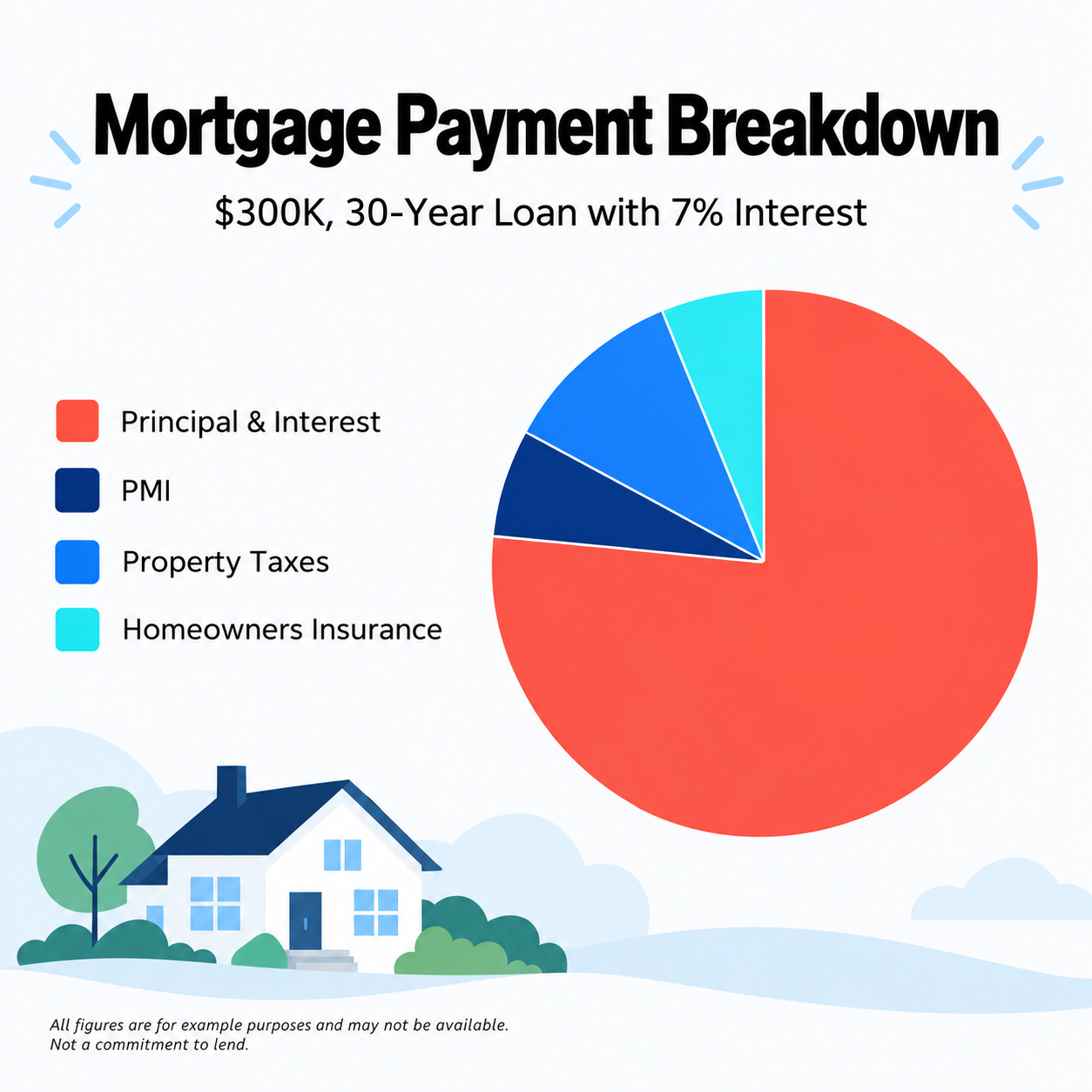
While Principal and Interest are the core of the mortgage, your actual monthly payment will almost certainly be higher. Most lenders require an escrow account, which collects money for property taxes and homeowners insurance alongside your P&I payment. This combined payment is known as PITI (Principal, Interest, Taxes, Insurance).
Additionally, if your down payment is less than 20% of the home's purchase price, you will likely be required to pay Private Mortgage Insurance (PMI). PMI protects the lender in case you default on the loan. It is an added monthly cost that does not benefit the homeowner.
There is no one-size-fits-all mortgage. The US market offers several different types of loans designed to meet different financial situations.
These are the most common type of mortgage. They are not backed by the government and are offered by private lenders like banks and credit unions. Conventional loans typically require a credit score of at least 620 and a down payment ranging from 3% to 20%. If you put down 20%, you avoid PMI.
Insured by the Federal Housing Administration, FHA loans are designed for first-time homebuyers and those with lower credit scores. They allow down payments as low as 3.5% and accept credit scores starting around 580. However, they require both an upfront mortgage insurance premium and an annual premium, which often lasts for the life of the loan.
Backed by the Department of Veterans Affairs, VA loans are available to active-duty military members, veterans, and eligible surviving spouses. They are one of the most powerful mortgage tools available because they often require 0% down payment and do not require PMI.
Offered by the US Department of Agriculture, these loans are designed to help low-to-moderate-income families buy homes in designated rural areas. They also offer 0% down payment options.
Beyond the type of backing, mortgages are also categorized by how their interest rates behave.
A Fixed-Rate Mortgage has an interest rate that remains the same for the entire term of the loan. A 30-year fixed mortgage is the most popular choice in America because it offers complete predictability—your monthly P&I payment will never change, regardless of what happens to the economy or inflation.
An Adjustable-Rate Mortgage (ARM) starts with a lower introductory rate for a set period (usually 5, 7, or 10 years). After that period, the rate adjusts annually based on market indexes. While ARMs can save you money in the short term, they carry the risk of significantly higher payments if interest rates rise.
Getting approved for a mortgage requires proving to a lender that you are a safe credit risk. Lenders look at three primary factors:
The journey to getting a mortgage involves several steps: pre-approval, house hunting, making an offer, submitting a full loan application, the lender's underwriting process (where they verify your income and assets), the home appraisal, and finally, the closing. At closing, you will sign the final paperwork and pay your closing costs.
Understanding how a mortgage works empowers you to make smarter financial decisions. Before you start house hunting, use our mortgage calculator to understand the true monthly cost, including taxes and insurance.