The down payment is the amount of cash you pay upfront when buying a home. The rest of the purchase price is covered by your mortgage loan. While the traditional advice is to put 20% down, the reality is that many US buyers put down much less. Understanding how much you should put down is crucial for your long-term financial health, your monthly payment, and your ability to qualify for a mortgage in the first place.
A down payment is a percentage of the home's purchase price that you pay in cash at closing. For example, if you buy a $400,000 home and put down 10% ($40,000), your mortgage loan will be for the remaining $360,000.
The down payment is not the only cash you need at closing. You will also need to pay closing costs (usually 2% to 5% of the loan amount) and potentially prepay property taxes and insurance into an escrow account. Therefore, your total cash needed at closing will be higher than just the down payment.
While the traditional advice is to put 20% down, many US buyers put down much less. Here is a breakdown of the most common options:
This is the traditional advice. Putting 20% down eliminates the need for Private Mortgage Insurance (PMI), which saves you money every month. It also immediately gives you significant equity in your home, making you less likely to end up "underwater" (owing more than the home is worth) if home values drop.
You will likely have to pay PMI, but you may be able to cancel it sooner if home values rise. It is a popular middle-ground for buyers who want to keep some cash reserves for emergencies or home renovations.
Common for first-time homebuyers. It allows you to enter the market faster, but monthly payments will be higher due to PMI. Conventional loans often allow 5% down, and some lenders offer 3% down programs.
Offered through FHA loans (Federal Housing Administration). These are popular for buyers with lower credit scores or limited savings. However, FHA loans require both an upfront mortgage insurance premium and an annual premium that often lasts for the life of the loan.
Available through VA loans for veterans and active-duty military, and USDA loans for rural properties. These are incredibly valuable programs because they require no down payment and often have competitive interest rates.
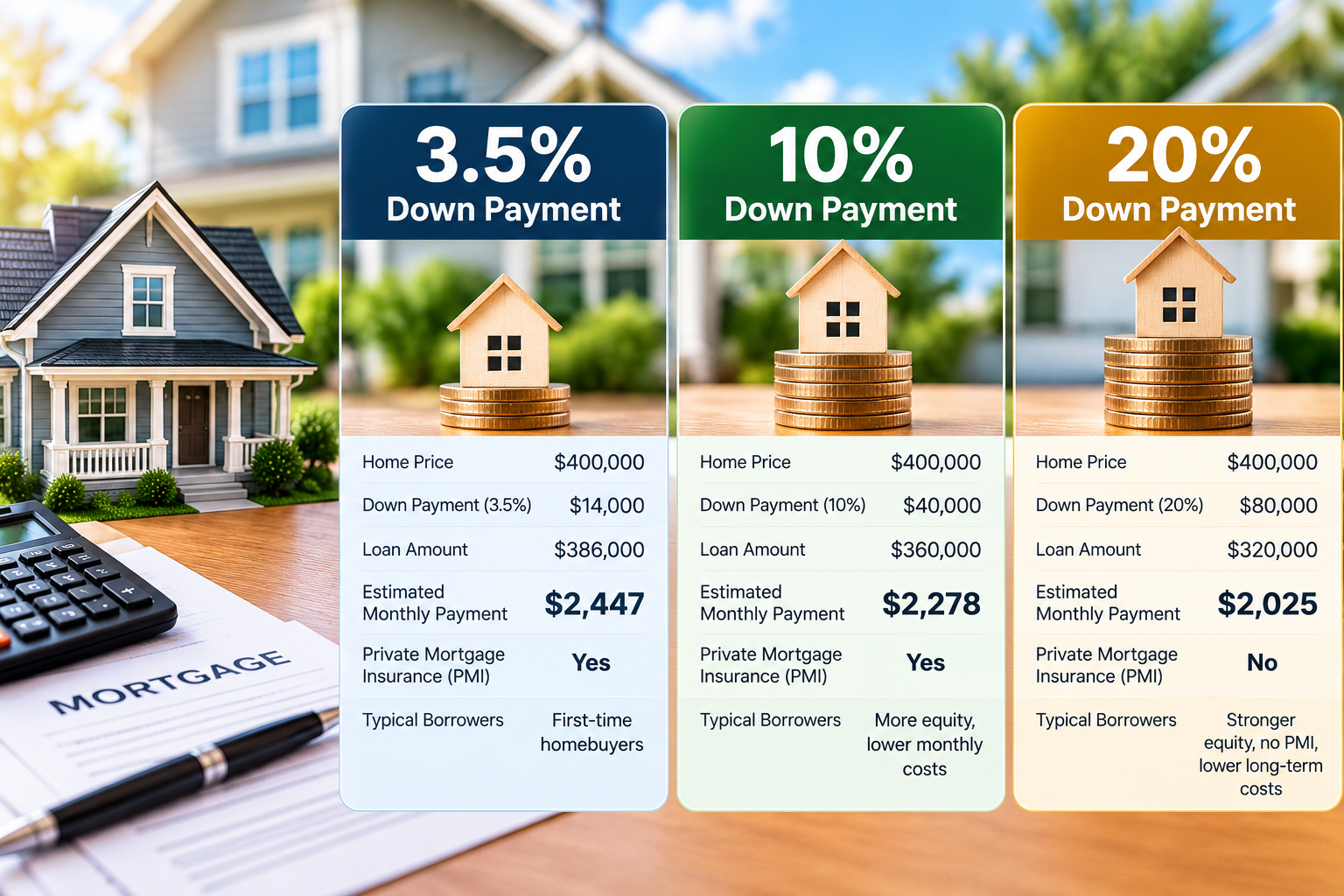
Calculating your down payment is simple math: Home Price x Down Payment Percentage = Down Payment Amount.
For example, if you are buying a $400,000 home and want to put 10% down, you multiply $400,000 by 0.10, which equals $40,000. You will then need a mortgage for the remaining $360,000.
If you want to put 3.5% down on a $400,000 home, you multiply $400,000 by 0.035, which equals $14,000. Your mortgage would be for $386,000.
When saving for a down payment, do not drain your entire savings account. You will also need cash for closing costs (usually 2% to 5% of the loan amount), moving expenses, and an emergency fund for unexpected home repairs.
For example, on a $360,000 loan, you might need an additional $7,000 to $18,000 just for closing costs. If you put all your cash into the down payment, you might not have enough to actually close the deal. A good rule of thumb is to keep at least 3 months of living expenses in savings even after you close on the home.
Many first-time buyers use gift funds from family members to cover their down payment. US lenders usually allow this, but they will require a "gift letter" signed by the donor stating that the money is a gift, not a loan. You will need to document the transfer of funds carefully, and the money must be in your account before closing. FHA loans have specific rules about who can gift funds (usually family members only), while conventional loans are more flexible.
Your down payment directly impacts two things: your loan amount and your PMI. A larger down payment reduces the amount you need to borrow (the principal), which lowers your monthly payment. Additionally, if you put down 20% or more, you avoid PMI entirely.
Use our mortgage calculator to see how different down payment amounts affect your monthly payment. You will quickly see that while a larger down payment requires more cash upfront, it can save you hundreds of dollars per month and tens of thousands of dollars over the life of the loan.