When applying for a mortgage in the US, one of the biggest decisions you will make is the loan term. The two most common options are a 30-year fixed-rate mortgage and a 15-year fixed-rate mortgage. Both have pros and cons depending on your financial goals, your monthly budget, and your long-term plans. Choosing the wrong one could cost you tens of thousands of dollars or stretch your budget to the breaking point. Here is a complete comparison to help you decide.

The 30-year mortgage is the most popular choice in America. Because the loan is spread over a longer period, the monthly principal and interest payments are significantly lower than a 15-year loan. This provides more cash flow and flexibility. You can use the money you save each month to invest, build an emergency fund, or pay for other expenses.
However, the trade-off is significant. Because you are borrowing money for 30 years, you will pay much more in total interest over the life of the loan. The interest rate is also usually slightly higher than a 15-year term, because the lender is taking on more risk over a longer period.
For example, on a $300,000 loan at a 6.5% interest rate, the monthly principal and interest payment is about $1,896. Over 30 years, you will pay roughly $382,000 in interest. You will have paid more in interest than the original loan amount.
With a 15-year mortgage, you pay off the loan twice as fast. This means your monthly payment will be higher, but you will save tens of thousands of dollars in interest. Additionally, lenders typically offer a lower interest rate for 15-year loans because they take on less risk. The downside is that a higher monthly payment leaves less room in your budget for emergencies or other investments.
Using the same $300,000 loan at a slightly lower 5.8% interest rate, the monthly payment jumps to about $2,504. However, over 15 years, you will only pay about $150,000 in interest. That is a savings of over $230,000 compared to the 30-year loan.
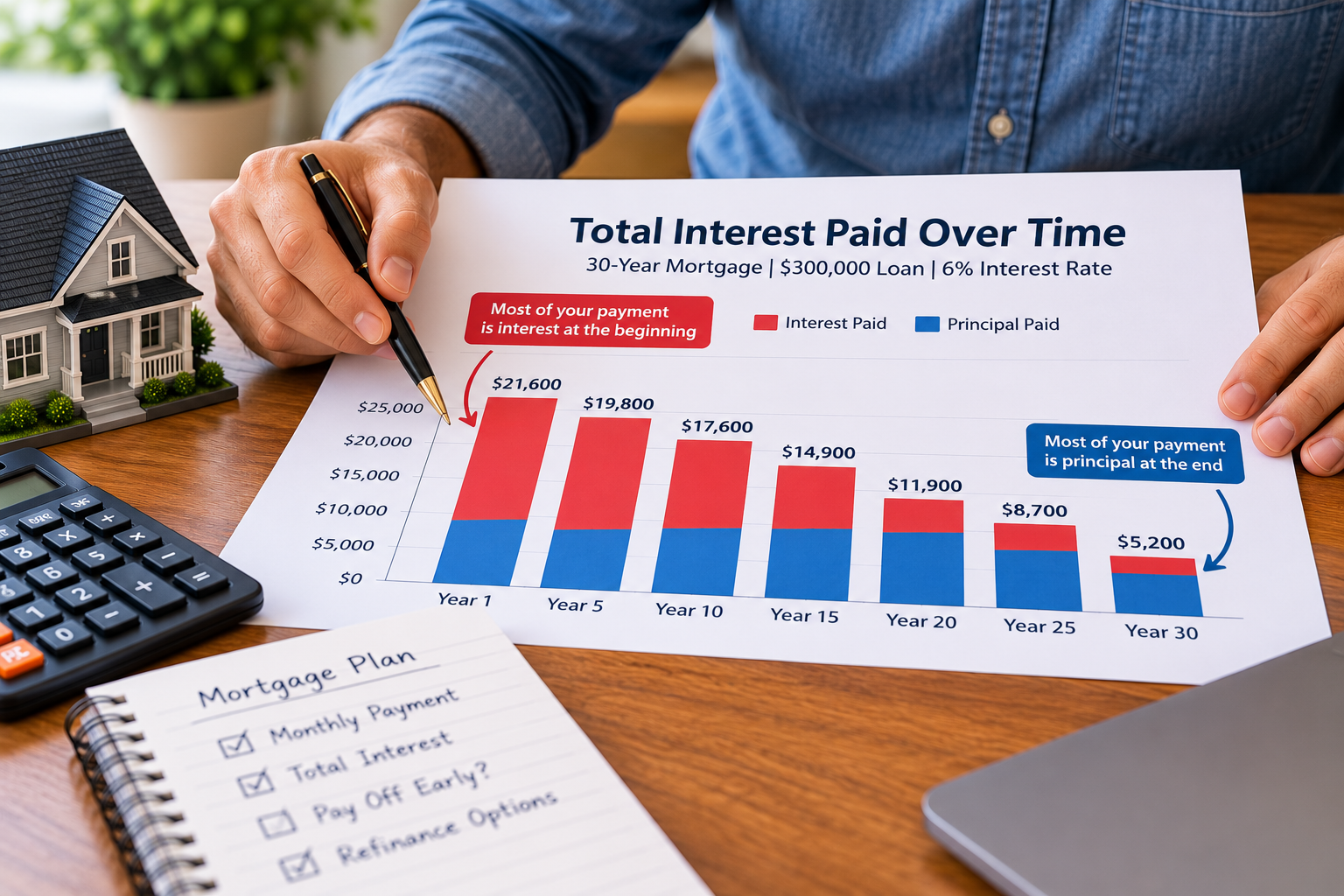
The difference in monthly payment is the biggest hurdle for most buyers. If you want to see how the interest breaks down over time, read our guide on how mortgage interest is calculated. In the example above, the 15-year payment is about $608 more per month. If you can comfortably afford that extra $608 without becoming "house poor," the 15-year loan is a fantastic financial move. You will be debt-free in half the time and save a fortune in interest.
However, if the higher payment leaves you with no savings and no breathing room, the 30-year mortgage is the safer choice. The flexibility of a lower payment can be a lifesaver if you lose your job or face a medical emergency.
If you have a stable, high income and want to be debt-free as quickly as possible, a 15-year mortgage is excellent. If you want lower monthly payments so you can invest your money elsewhere or have more breathing room, a 30-year mortgage is usually the safer choice.
Many homeowners choose a 30-year loan but make extra payments each month to pay it off early without being locked into a high mandatory payment. This gives you the best of both worlds: the safety of a low required payment and the savings of a faster payoff.
If you are in your 20s or 30s and plan to stay in the home for decades, a 30-year mortgage gives you more flexibility to invest in other areas of your life. If you are closer to retirement and want to enter your golden years without a mortgage payment, a 15-year loan might be the better choice.
Use our mortgage calculator to compare the monthly payments and total interest for both loan terms. Seeing the numbers side by side will help you make an informed decision that fits your financial situation.