When you sign the paperwork for a 30-year fixed-rate mortgage, you agree to make 360 identical monthly payments. To a new homeowner, it might seem logical that each payment chips away at the loan balance equally. However, that is not how mortgages work. The way your loan is paid off is dictated by an amortization schedule, and understanding it is crucial to saving money on interest and paying off your home faster.

An amortization schedule is a complete table showing every single monthly payment you will make over the life of your loan. For each payment, the schedule breaks down exactly how much money is going toward interest and how much is going toward the principal balance. It also shows the remaining balance of the loan after each payment is made.
Lenders are required to provide you with an amortization schedule when you close on your loan, but many borrowers throw it away without looking at it. This is a mistake. The schedule is your roadmap to understanding the true cost of your mortgage.
The most important takeaway from an amortization schedule is that mortgage interest is "front-loaded." In the first few years of a 30-year loan, the vast majority of your monthly payment goes toward paying interest, while only a tiny fraction goes toward the principal.
For example, imagine a $300,000 loan at a 6.5% interest rate. Your monthly Principal and Interest payment would be approximately $1,896. In the very first payment, roughly $1,625 will go straight to the lender as interest, and only $271 will go toward reducing your $300,000 debt. Even though you made a nearly $1,900 payment, your balance barely moved.
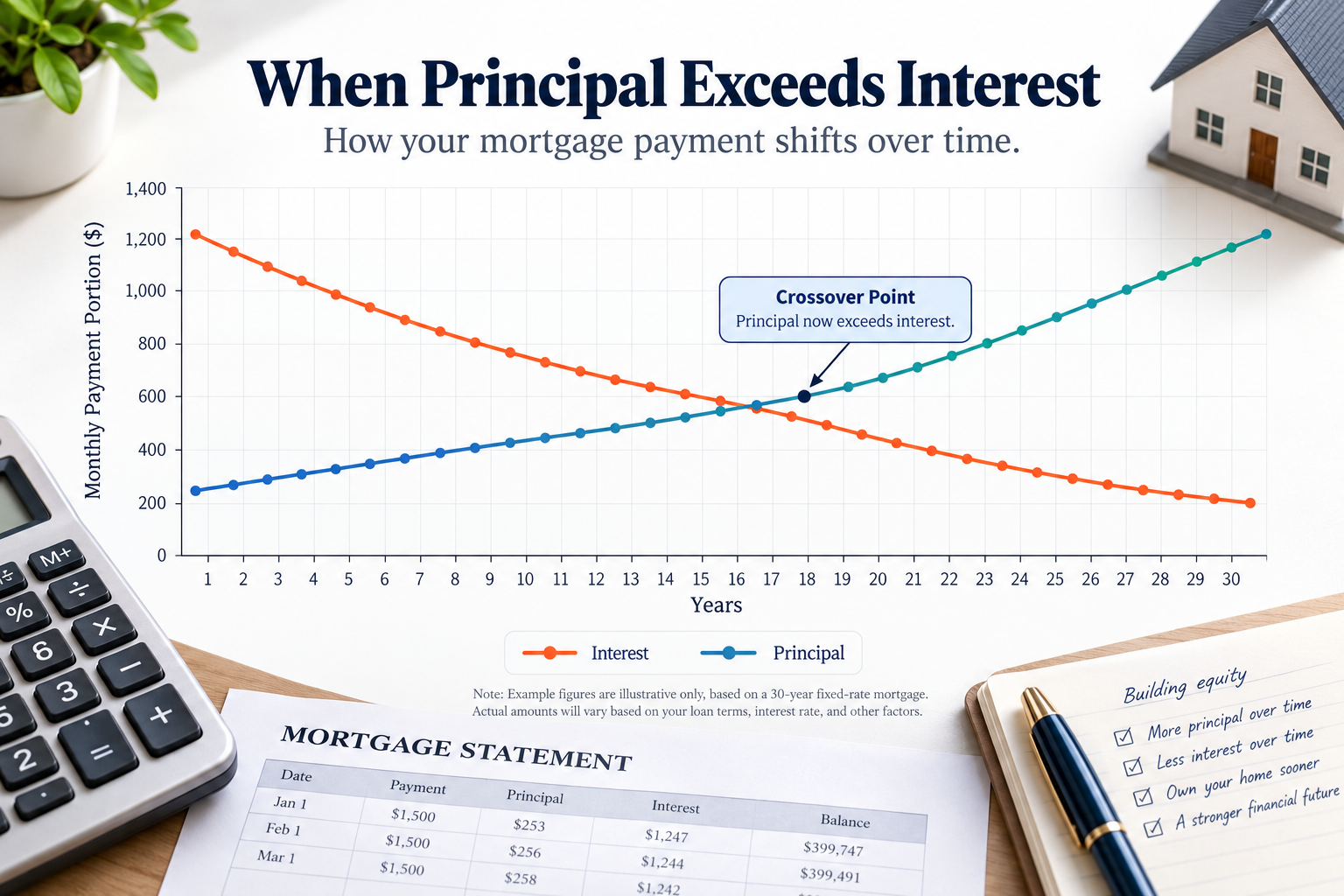
As the years go by, your loan balance slowly decreases. Because interest is calculated based on the remaining balance, the interest portion of your payment gets smaller each month. This allows a larger portion of your fixed payment to go toward the principal. Eventually, you reach a "crossover point" (usually around year 15 or 16 on a 30-year loan) where the amount going to principal finally exceeds the amount going to interest. From that point on, your loan balance drops rapidly.
This is why it feels like you are not making progress in the first five years of your mortgage. You are paying the bank's profit first, and your equity is growing very slowly. It is only in the second half of the loan that you start to build equity quickly.
Understanding the amortization schedule explains why selling a house after only a few years can be financially painful. If you buy a home and sell it after three years, you may be shocked to find that you still owe almost the exact amount you originally borrowed, because so little of your payments went toward the principal. This is why you need to stay in a home for at least 5 to 7 years to recoup the costs of buying and selling.
It also explains why making extra payments is so powerful. If you make an extra payment toward the principal, you reduce the balance immediately. This means the next month, you will be charged less interest. Because your monthly payment amount is fixed, that saved interest allows even more of your payment to go toward the principal, creating a snowball effect.
A 15-year mortgage has a much steeper amortization curve. Because the loan term is half as long, the monthly payment is significantly higher, but the amount going toward principal is much larger from day one. While a 30-year loan might cost you $250,000 in interest over its life, a 15-year loan on the same amount might only cost $100,000.
The amortization schedule clearly shows the massive interest savings of choosing a shorter term. If you can afford the higher monthly payment, the 15-year loan will build equity much faster and save you a fortune over time.
You can also generate an amortization schedule easily using our mortgage calculator, which includes a year-by-year amortization table. Look at the difference between year 1 and year 10. Seeing the numbers in black and white is often the motivation people need to start making extra payments.
When reviewing your schedule, pay attention to three columns: the payment number, the principal portion, and the interest portion. Track how the interest portion shrinks and the principal portion grows. This will give you a clear picture of your financial progress and help you decide if a refinance or extra payments are right for you.